Home battery backup

Keep the important parts of home running when the grid goes down

PTX plans automatic battery backup around the home's electrical service, the loads your household actually needs and the approvals required in British Columbia. The first step is an assessment—not a one-size-fits-all equipment sale.

Illustration of a planned home battery-backup installation at a house
100 A and 200 A planning paths
Essential-load design
Automatic outage response
Approval-led installation

01

Two clear planning paths

These are assessment pathways, not fixed equipment promises. Final capacity, output and equipment are confirmed only after site review and approval.

Home Backup 100

For homes with a 100 A electrical service. PTX identifies the circuits that should remain available, measures or calculates demand, reviews the panel and develops a practical backup arrangement without assuming the entire service must operate at once.

Home Backup 200

For homes with a 200 A electrical service or a larger priority-load list. The design considers higher simultaneous demand, transfer equipment, distribution changes and whether some loads should be automatically managed or excluded.

A planning target, not a shelf product

Storage and power targets are refined from household priorities and verified equipment. PTX will not publish or promise a specific battery brand or configuration until the exact Canadian-certified system and transfer architecture are approved.

Expandable where the approved system allows

If future solar, EV charging or added storage is important, that goal should be identified before equipment and pathways are selected. Expandability depends on the approved system design.

02

Choose what the battery needs to carry

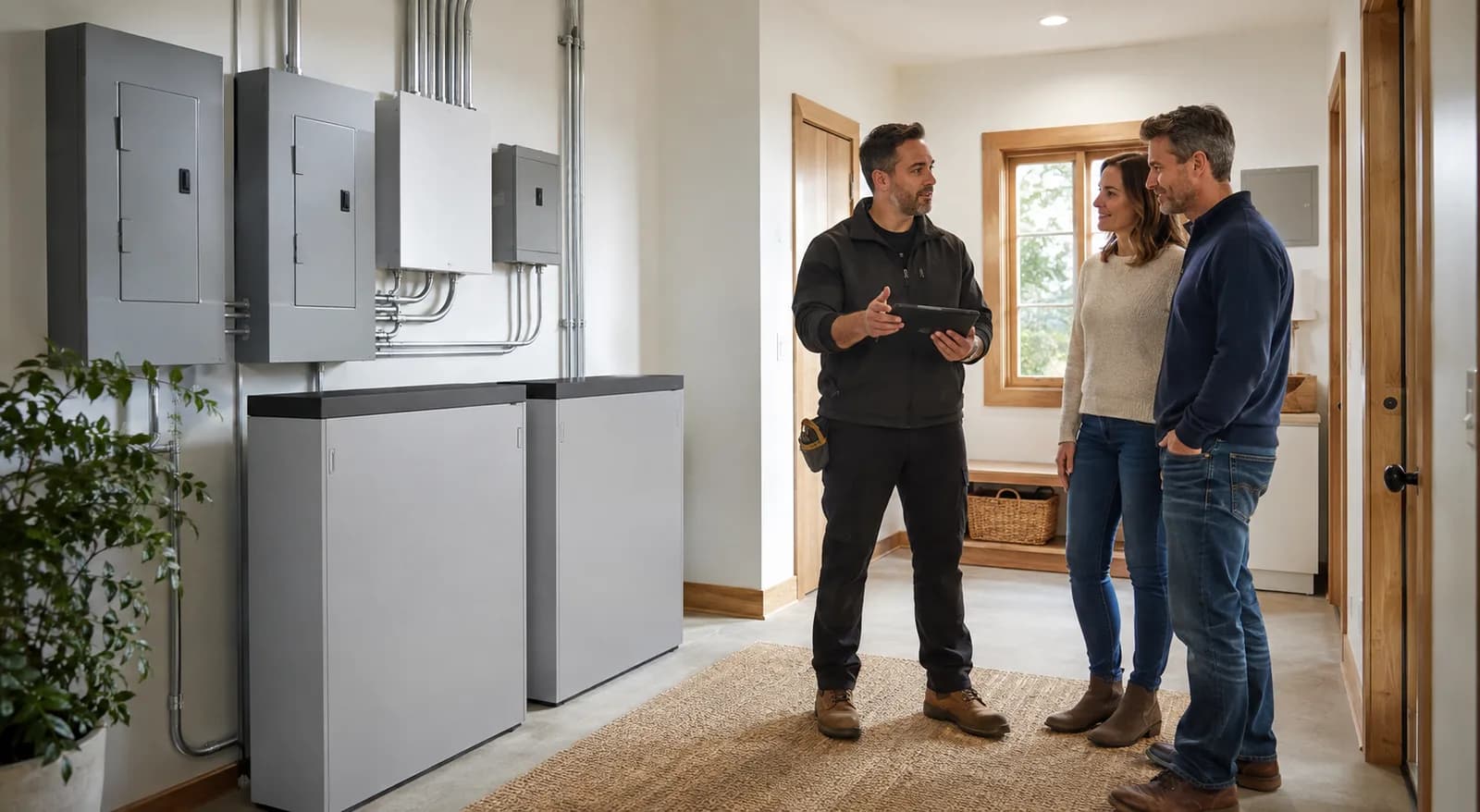
Illustration of an electrician discussing a planned home battery-backup system with homeowners
Illustrative planning concept. Final equipment, capacity and placement depend on the site assessment, approved design and certified products.

Usually protected first

Refrigeration, selected lighting, communications, security, sump or drainage equipment, gas-appliance controls and essential receptacles are common priorities.

Possible with careful design

Well pumps, selected kitchen appliances, home-office equipment and some heating or cooling loads may be included when starting current, operating demand and desired runtime support them.

Often managed or excluded

Electric resistance heat, large hot tubs, saunas, electric ranges, multiple large motors and high-rate EV charging can consume storage quickly and may require load controls or manual operating rules.

Runtime is a household decision

A larger priority list does not create more stored energy. PTX explains the trade-off between the number of active loads, their power demand and how long the available storage may last.

03

What happens during an outage

1. The grid supply is lost

Approved transfer equipment isolates the backed-up electrical system from the utility supply so the installation cannot energize utility lines.

2. Backup starts automatically

The battery system supplies the designed backup panel or circuits. Actual transfer behaviour depends on the approved equipment and configuration.

3. Priority rules protect runtime

Load controls or household operating rules keep non-essential high-demand equipment from exhausting the battery earlier than expected.

4. Grid service returns

The system returns the home to normal utility supply and recharges according to its approved operating settings.

04

The PTX assessment and delivery path

1. Define the outcome

Confirm the outage concerns, household priorities, expected runtime, future solar or EV plans and whether time-of-day operation matters.

2. Review the electrical system

Document service rating, panel and feeder arrangement, grounding, available space, major loads, installation areas and cable routes.

3. Build the load plan

Separate essential, optional and excluded loads, then model realistic combinations rather than relying on breaker labels alone.

4. Confirm equipment and approvals

Select an acceptable certified system, prepare the utility and permit path and confirm technical acceptance before installation where required.

5. Install, test and explain

Complete the approved electrical work, verify transfer and operating behaviour, document the system and show the household how to manage loads during an extended outage.

6. Plan for maintenance

Keep shutdown instructions, monitoring access, emergency information and manufacturer maintenance requirements with the home's electrical records.

05

Resilience first; savings are secondary

Optional time-of-day rates

BC Hydro's optional residential time-of-day rate currently discounts energy used from 11 p.m. to 7 a.m. and adds a premium from 4 p.m. to 9 p.m. A compatible battery may shift some grid use, but savings depend on tariff, efficiency and household behaviour.

Solar and self-generation

A compatible battery can store onsite solar energy for later use. Grid-connected solar and battery systems still require the current BC Hydro self-generation application and technical acceptance path.

Rebates and connected-device programs

Battery rebates and Peak Saver participation depend on current eligibility, approved products and program terms. PTX checks the live program rather than promising an incentive in advance.

No unsupported payback promise

Backup value is primarily continuity and resilience. PTX will not promise a fixed annual saving or payback period without a household-specific energy model and current program confirmation.

Questions

What customers usually need to know

Will a home battery run everything in my house?

Not necessarily. Large electrical loads can use stored energy quickly. PTX creates a priority-load plan and confirms what can operate together before the system is specified.

What is the difference between the 100 A and 200 A pathways?

They begin with the home's electrical-service size and likely backup demand. The final design depends on the actual panel, connected loads, runtime goal and approved equipment—not service size alone.

Does the battery take over automatically?

The intended design uses approved automatic transfer equipment, but exact transfer time and operating behaviour depend on the selected certified system and final architecture.

Can I add solar later?

Often, if future solar compatibility is designed in from the beginning. The final answer depends on the battery, inverter, utility application and available installation pathways.

Can PTX install a battery before BC Hydro approves it?

No. BC Hydro states that battery energy-storage systems require approval before installation, including systems that will not export energy to the grid.

Are rebates guaranteed?

No. Eligibility depends on current program rules, property and account requirements, approved equipment, pre-approval and installation timing. PTX can help confirm the current path before purchase.

What should I send for an initial assessment?

Useful starting information includes the service address, a clear photo of the electrical panel and main rating, the most recent BC Hydro bill, the loads you want during an outage and safe photos of possible indoor or outdoor equipment locations.


Start with useful information

Tell PTX about the property, problem and timing.

For planned work, send the address, access context and safe photographs. For an urgent electrical safety concern, call the 24-hour emergency phone line.